

Patio slab & pedestal calculator: both counts
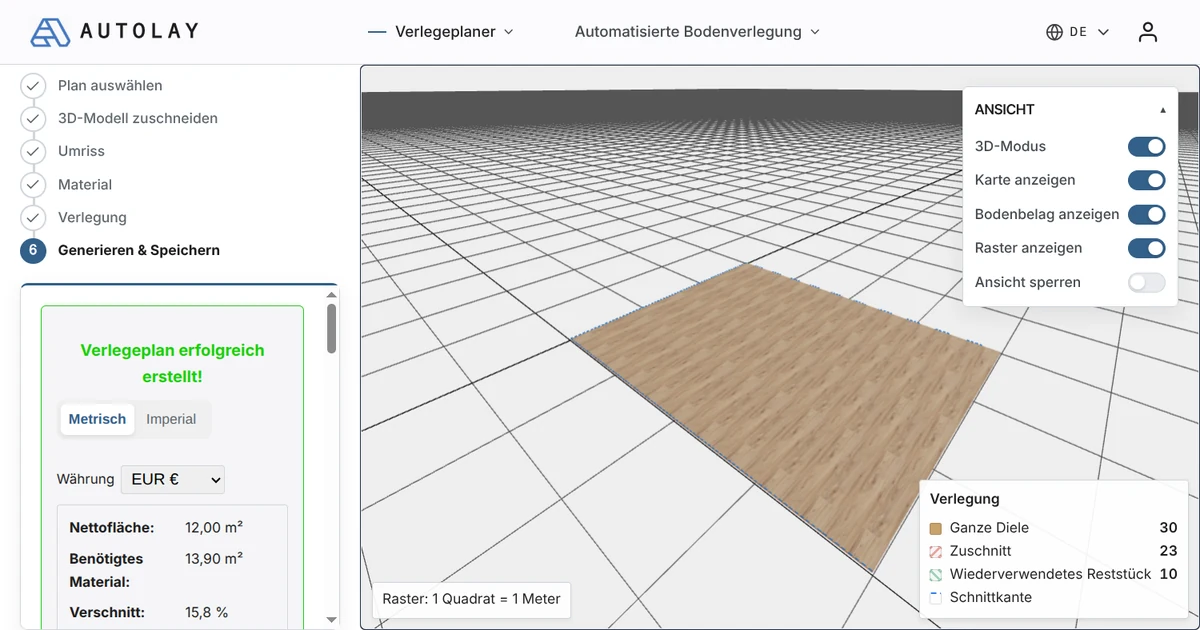
A raised terrace takes two counts, not one: the slabs, and the adjustable pedestals under them — one at every joint crossing, plus the edges and, on large-format slabs, a center support. Both follow the real slab grid, the joint width and the perimeter cuts, so the area alone cannot give either. This calculator sets out your own terrace outline and returns both counts with the real waste percentage, free in the browser.
Calculate my terrace →
What a patio slab calculator has to do
Multiplying square feet by a rule of thumb gives two rough numbers, not an answer. A calculator earns its place only when it turns your real terrace into real quantities:
- Count the whole slabs and the cut slabs at the edges from the real terrace outline — not the area rounded up.
- Work out the pedestal count from the slab grid: a support sits under every joint crossing, with the edges and, for large-format slabs, a center support included.
- Take the slab format and joint width you actually lay, because the pedestals sit under the joints and the grid sets their positions.
- Return a cut list for the perimeter slabs and the waste percentage, so the order is exact before you buy.
From terrace outline to slab and pedestal list in four steps
- Bring the terrace in: a photo of the plan, a PDF, an IFC building model or a 3D scan.
- Trace the outline and set the scale, so every following number is in real feet.
- Pick the slab format and the joint width you are laying.
- Get the slab count, the pedestal count, the waste percentage and the cut list, then order against it.
Why the rule-of-thumb numbers are usually wrong
Slabs by area, pedestals by rule of thumb
Most free calculators divide the area by the slab size and assume a flat number of pedestals per square foot. It is fast, but blind to the terrace: it never sees the real grid, so the slab count and especially the pedestal count drift from what the layout needs.
Why the grid sets the pedestal count
Adjustable pedestals sit at the slab corners, so their number follows the grid — one under each joint crossing, plus the supports along the edges. Large-format slabs add a center support, which a per-square-foot rule cannot see.
Why laying out the terrace is exact
A planner that lays out each slab knows the grid, the edges and the perimeter cuts, so the slab count, the pedestal count and the waste percentage are real for your terrace instead of two rounded guesses.
Frequently asked questions about the patio slab & pedestal calculator
- How many terrace slabs do I need?
- The planner counts the whole slabs plus the cut slabs at every edge from your traced terrace, so the number is the real count for your layout — not the area rounded up.
- How many pedestals does the terrace take?
- The pedestal count follows the slab grid: a support under each joint crossing, plus the edges and a center support for large-format slabs. The planner derives it from the real layout, not from a flat count per square foot.
- Is it free, and are the numbers exact?
- Yes — it runs free in your browser and computes the slab count, pedestal count, waste percentage and cut list from your own terrace outline, instead of applying one fixed formula.
- Does the slab format change the number of pedestals?
- Yes. Pedestals sit at the joint crossings, so a larger slab means fewer crossings over the same area — but large-format slabs also need a center support to stop them flexing. The calculator applies both rules to the grid your format produces instead of quoting one pedestal-per-square-foot figure.
- Can I calculate a terrace that is not rectangular?
- Yes. You trace the real outline, including corners, steps and angled edges, and the slabs are set out against it. The perimeter is where the cut slabs and the extra edge supports appear, which is exactly what an area-based estimate leaves out.
Get the slab and pedestal count for your own terrace
Autolay's free planner takes a photo of your terrace plan, an IFC building model or a 3D scan, lays out the slabs at your format and joint width, and computes the exact slab count, pedestal count, waste percentage and cut list before you order anything.