Screed calculator
Screed is sold by the bag of dry mortar, but you plan it by area and thickness, and the construction decides how thin it may be. The calculator gives the weight and bags to order with an allowance for an uneven base, the mixing water, the poured volume and a warning when the screed is thinner than its construction allows.
Calculate the quantityHow much screed do you need?
Enter the floor area and the thickness, then pick the screed type and the construction. The type sets the consumption from the data sheets, which you can still edit; the construction sets the minimum thickness the calculator checks.
Minimum for this construction: 1.8 in
Default value – replace it with the manufacturer’s figure.
5 % covers the usual unevenness and mixer losses; measure the depth at several points and use the average.
Optional – shows the material cost for the rounded-up amount.
You need
Enter a floor area and a thickness to see the quantity.
The result updates as you type – no button to press.
Quantity = area × thickness × consumption per cm × (1 + allowance). Poured volume = area × thickness.
Figures are for the screed layer only, not the insulation or leveling compound. Water per bag and minimum thicknesses are typical values (cement screed after DIN 18560, calcium sulfate screed after current manufacturer data sheets); the bag of your product has the last word. Default thickness: 2 in.
Getting the thickness right
- The minimum thickness depends on the construction. Cement screed: bonded at least 25 mm (1 in), on a separating layer 35 mm (1-3/8 in), floating on insulation 45 mm (1-3/4 in), heated 45 mm above the pipes (DIN 18560). Calcium sulfate flowing screed, according to current manufacturer data sheets: bonded 25 mm, on a separating layer 30 mm, floating 35 mm, heated 35 mm above the heating element.
- Over underfloor heating, add the pipe itself: a 17 mm pipe under 45 mm of cover makes a cement screed at least 62 mm (2-1/2 in) thick.
- Measure the depth at several points with a laser or a level and straightedge and use the average; the allowance covers the usual unevenness, not a slope of several centimeters.
- Calcium sulfate screed does not belong in rooms that stay wet, and it must not get wet while it dries; wet rooms, garages and anything outdoors get cement screed.
- Lay cement screed in fields of up to about 40 m² (430 sq ft) with no side longer than about 8 m (26 ft), and put a joint in every doorway, as the data sheet of a bagged cement screed asks.
Consumption, water and bags by screed type
Dry mortar per m² for each centimeter of thickness (per 100 sq ft for each inch), water and bag size from the data sheets:
| Screed type | Typical consumption |
|---|---|
| Cement screed (bagged, strength class CT-C20-F4) | ≈ 20 kg/m² per cm (1040 lb per 100 sq ft per in); 25 kg bags; about 2 l of water per bag |
| Calcium sulfate flowing screed | ≈ 19 kg/m² per cm (988 lb per 100 sq ft per in); 40 kg bags; about 6.5 l of water per bag |
What this calculator does — and does not
It does
Work out the dry mortar weight, the bags, the mixing water and the poured volume, with an allowance for an uneven base, and warn when the thickness is below the minimum for the construction you pick.
It does not
Measure your floor, plan the insulation or the heating pipes, or tell you when the screed is ready for the floor covering: that takes a calcium carbide moisture reading on site. Autolay’s planner handles the tiles, planks or laminate that go on top.
Laying screed step by step
For bagged screed in a home: from the bare slab to a screed that is ready for the floor covering.
Prepare the base
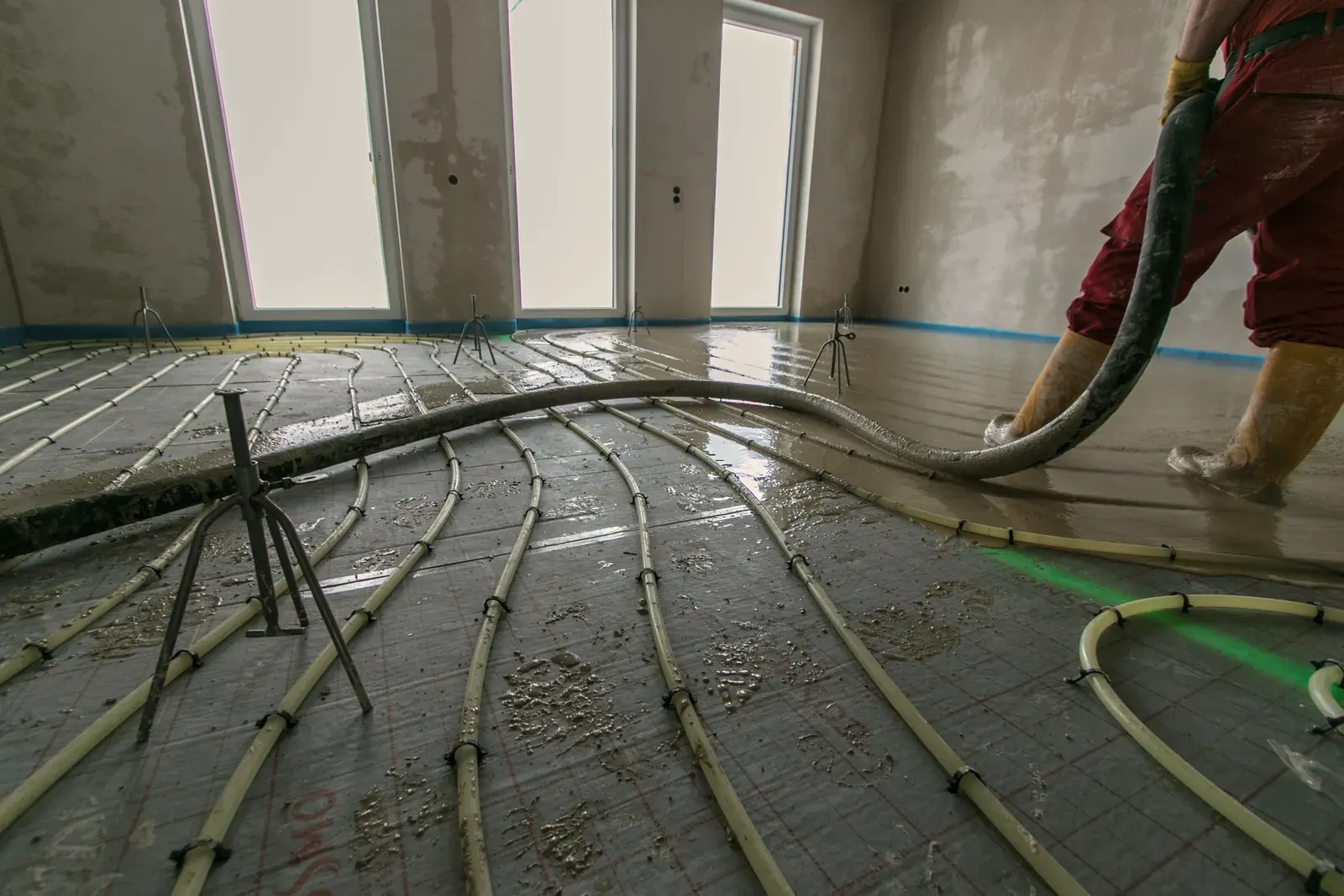
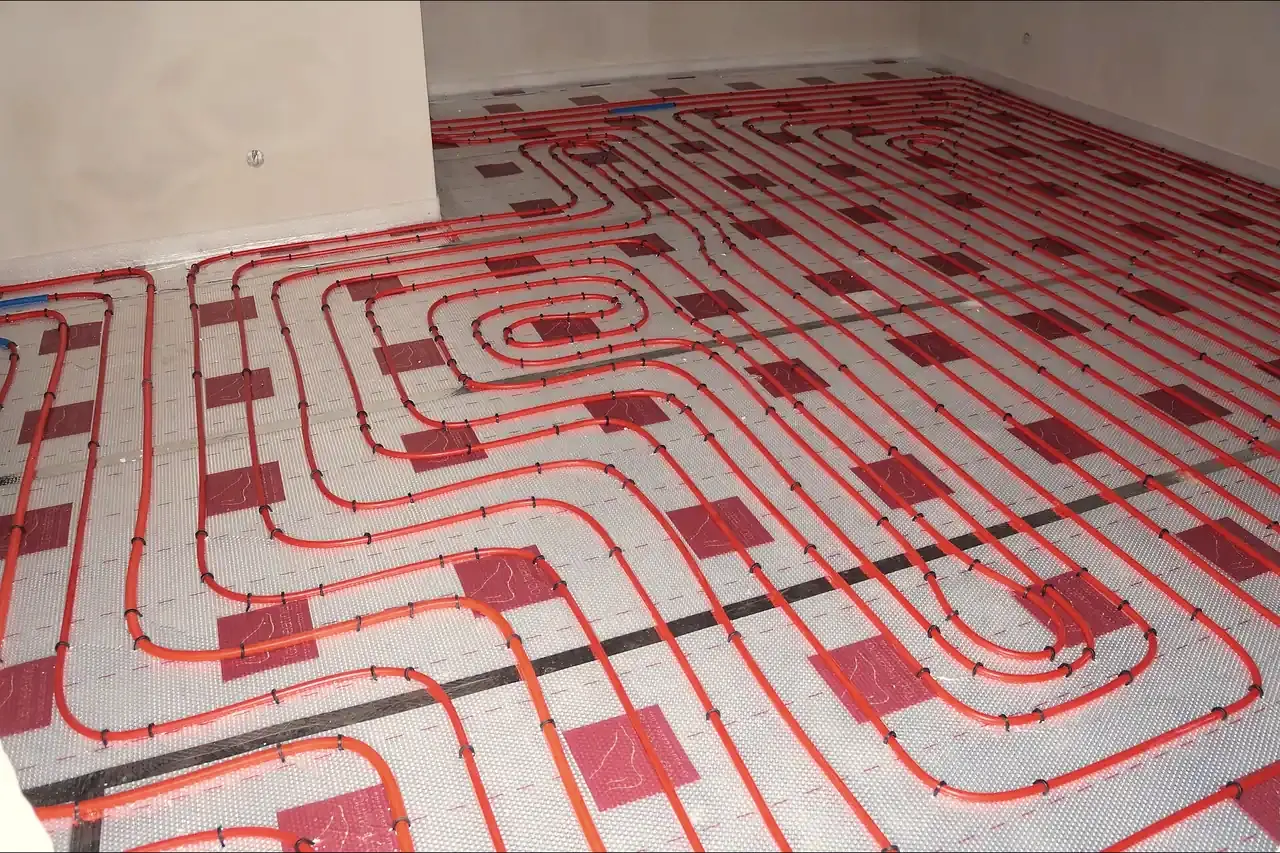
Sweep the slab, fill holes and bed pipes and cables in a level layer. For a floating screed lay the insulation boards tight and staggered; underfloor heating pipes are clipped onto the insulation and pressure-tested before any screed goes in.
Fit the edge strip and the separating foil
Fix an edge insulation strip along every wall, column and pipe, at least 5 mm thick (10 mm with underfloor heating), standing 2 to 3 cm above the finished floor. On insulation lay polyethylene foil at least 0.1 mm thick with 10 cm overlaps, turned up at the walls.
Set the height
Mark the finished screed level on the walls with a laser and set screed rails or leveling stands. Check the minimum thickness at the highest point of the base and over the pipes.
Mix
Mix cement screed earth-moist in a forced-action or drum mixer with the water printed on the bag (about 2 l per 25 kg) and use each batch within an hour. Calcium sulfate flowing screed is mixed lump-free with about 6.5 l per 40 kg and poured.
Spread, compact and pull off
Spread the screed between the rails, compact it, pull it off with a long straightedge, fill the rail grooves and float the surface. Flowing screed is worked through with a dapple bar to let the air out.
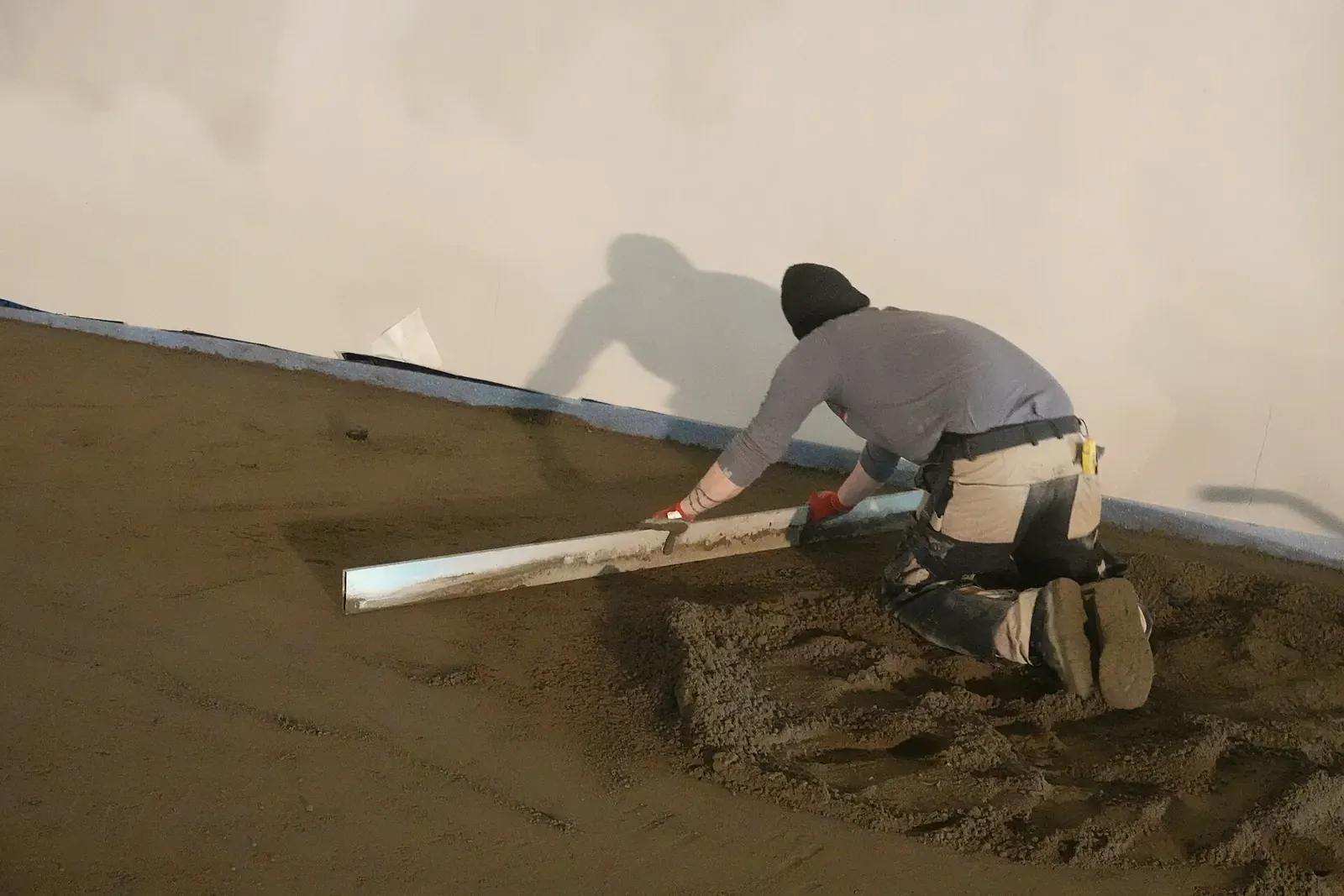
Photo: Smigel, CC BY-SA 4.0, via Wikimedia Commons Cure, heat up and dry
Protect the screed from draughts and direct sun at first, then air the room well (cement screed data sheets ask for intensive airing from day 2; calcium sulfate flowing screed is walkable after about 24 hours). Heated screed is heated up by protocol: calcium sulfate from day 7, cement screed after 21 days. Lay the floor only when the calcium carbide reading is below the limit.
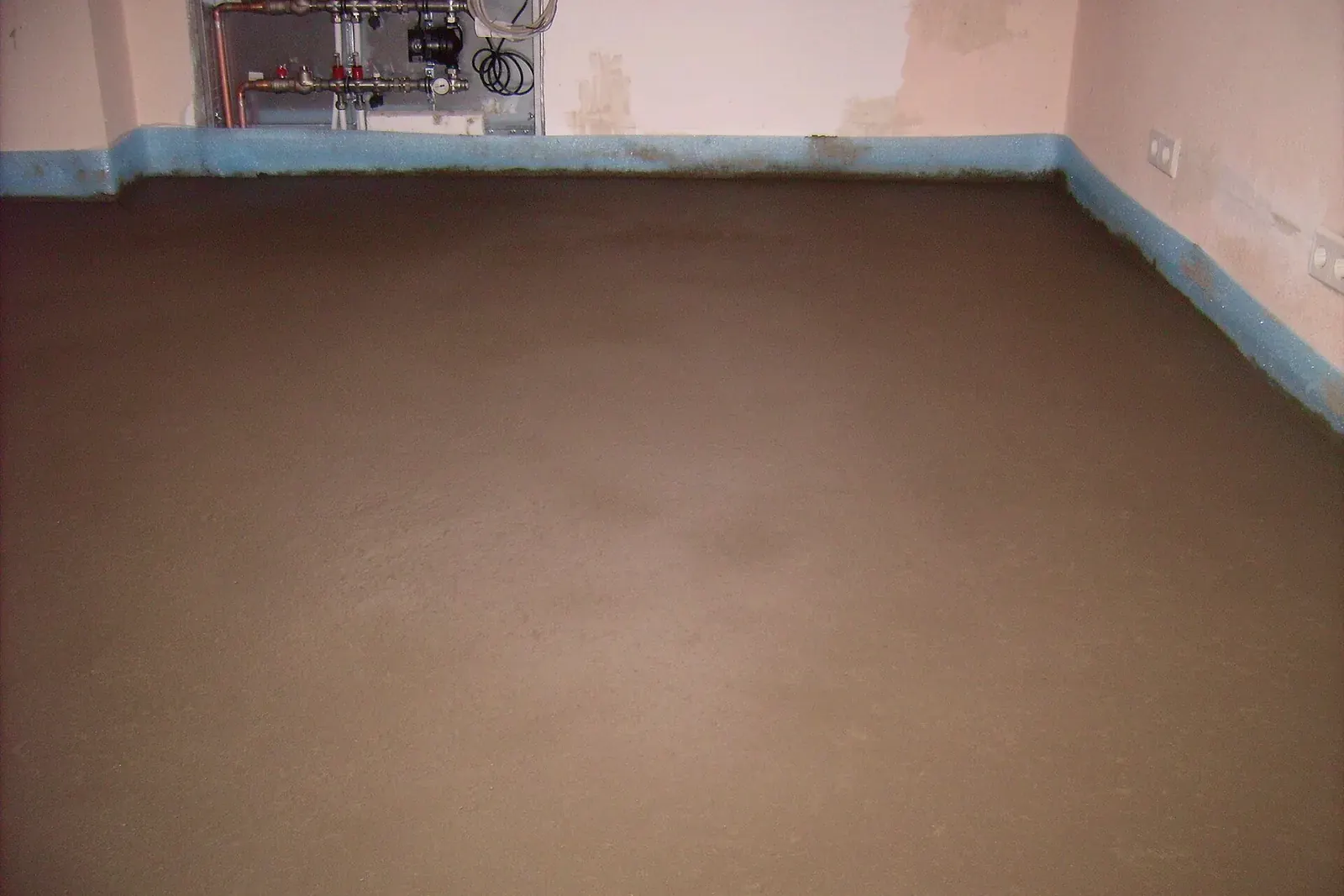
Photo: Hundehalter, CC BY-SA 3.0, via Wikimedia Commons
Minimum thickness, drying and moisture limit
| Screed and construction | Minimum thickness | Drying (rule of thumb) | Ready for covering (calcium carbide reading) |
|---|---|---|---|
| Cement, bonded | 25 mm (1 in) | about 1 week per cm up to 4 cm | below 2.0 % |
| Cement, on a separating layer | 35 mm (1-3/8 in) | 5 cm: about 6 weeks | below 2.0 % |
| Cement, floating | 45 mm (1-3/4 in) | 5 cm: about 6 weeks | below 2.0 % |
| Cement, heated | 45 mm above the pipe | heat-up after 21 days, then heat dry | below 1.8 % |
| Calcium sulfate flowing, bonded or on a separating layer | 25 or 30 mm | 35 mm: 3 to 6 weeks | below 0.5 % |
| Calcium sulfate flowing, floating | 35 mm | 35 mm: 3 to 6 weeks | below 0.5 % |
| Calcium sulfate flowing, heated | 35 mm above the heating element | heat-up from day 7 | below 0.5 %, 0.3 % advised |
Tools and materials
| Item | Quantity |
|---|---|
| Bagged screed | from the calculator |
| Edge insulation strip, 5 mm (10 mm with heating) | the room perimeter plus columns and pipes |
| Polyethylene foil, at least 0.1 mm | the area plus 10 cm overlaps and upturns at the walls |
| Forced-action or drum mixer | 1, rent per day |
| Screed rails or leveling stands | enough for parallel rails across the room |
| Rotary laser or a long level | 1 |
| Aluminum straightedge, 2 to 3 m | 1 |
| Float and smoothing trowel | 1 each |
| Wheelbarrow, buckets, water supply | per site |
| Knee boards | 1 pair |
| Calcium carbide moisture reading | before the floor covering goes down |
Common mistakes
No edge strip
How to spot it: Cracks along the walls; footsteps can be heard next door
Fix: Edge strip along every wall, column and pipe: 5 mm, 10 mm with heating
Too thin over pipes or insulation
How to spot it: Cracks that follow the pipe runs
Fix: Keep the minimum: cement 45 mm above the pipe, calcium sulfate 35 mm; raise the height if needed
Too much water in the mix
How to spot it: Soft, dusty surface; drying takes far longer
Fix: Use the water printed on the bag, measured, not by eye
No joints in doorways and large rooms
How to spot it: Cracks running from the door frames
Fix: A joint in every doorway; cement screed fields of up to about 40 m²
Laying the floor too early
How to spot it: Laminate swells, tiles crack, adhesive lets go
Fix: Calcium carbide reading below the limit before laying
Draught or sun in the first days
How to spot it: Curled edges and surface cracks
Fix: Protect the screed at first, then air the room regularly as the data sheet says
Calcium sulfate screed in a wet room
How to spot it: The surface softens and swells
Fix: Use cement screed in wet rooms, garages and outdoors
When to call a professional
One small room of bagged screed is within reach of a skilled amateur, but the work is heavy: about 100 kg of mortar per m² at 5 cm. Bring in a screed contractor when:
- The area is more than a room or two: a contractor pumps the screed in a day
- There is underfloor heating: pipe cover, heat-up and the drying protocol have to be documented
- You want calcium sulfate flowing screed: in practice it is pumped from a silo or a mixing pump, not mixed from bags by hand
- The base is several centimeters out of level, or needs insulation against sound or heat loss
- It is a wet room, a garage or anything outdoors
- A fixed date calls for a fast-drying screed
Frequently asked questions about screed
How much screed do I need per 100 sq ft?
About 1040 lb of dry mortar per 100 sq ft for each inch of cement screed (20 kg per m² per cm), or about 988 lb (19 kg per m² per cm) for calcium sulfate flowing screed. Worked example: 323 sq ft at 2 in of cement screed is 323 × 2 × 1040 ÷ 100 = 6 718 lb, which is 135 bags of 50 lb. With the default 5 % allowance it is 7 054 lb, 142 bags.
What thickness should I use?
Never less than the minimum for your construction: cement screed bonded 25 mm (1 in), on a separating layer 35 mm (1-3/8 in), floating 45 mm (1-3/4 in), heated 45 mm above the pipe; calcium sulfate flowing screed 25, 30, 35 and 35 mm. Above the minimum, the height of doors, thresholds and the adjoining floors decides.
How many bags is that, and how heavy is it?
The calculator divides the weight by your bag size and always rounds up. Keep the weight in mind: 5 cm (2 in) of screed weighs about 100 kg per m² (about 21 lb per sq ft), so a 20 m² (215 sq ft) room means more than 2 tonnes of bags to carry and mix by hand. For a whole floor, a screed contractor with a mixing pump is usually the better choice.
How long does screed take to dry before I can lay the floor?
Rule of thumb for cement screed: about one week per centimeter up to 4 cm, then about two weeks for each further centimeter, so a 5 cm screed needs about six weeks in good conditions. Calcium sulfate flowing screed needs about 3 to 6 weeks at 35 mm, according to current manufacturer data sheets. What counts is the calcium carbide reading before laying: cement screed below 2.0 %, calcium sulfate screed below 0.5 % (0.3 % with underfloor heating), the limits laminate manufacturers set.
Why does the result also show the volume and the water?
Ready-mixed screed from a truck or a pump is quoted by volume, bagged screed by weight, so the calculator shows both. The water figure is what you need on site: about 2 l per 25 kg bag of cement screed and 6.5 l per 40 kg bag of calcium sulfate flowing screed. Always use the amount printed on your bag; too much water weakens the screed and slows the drying.
Planning the flooring on top
Once the screed has cured, the free Autolay planner works out the tiles, planks or laminate for it — the material list and waste — from a photo of your floor plan, an IFC building model or a 3D scan.
Start planning